
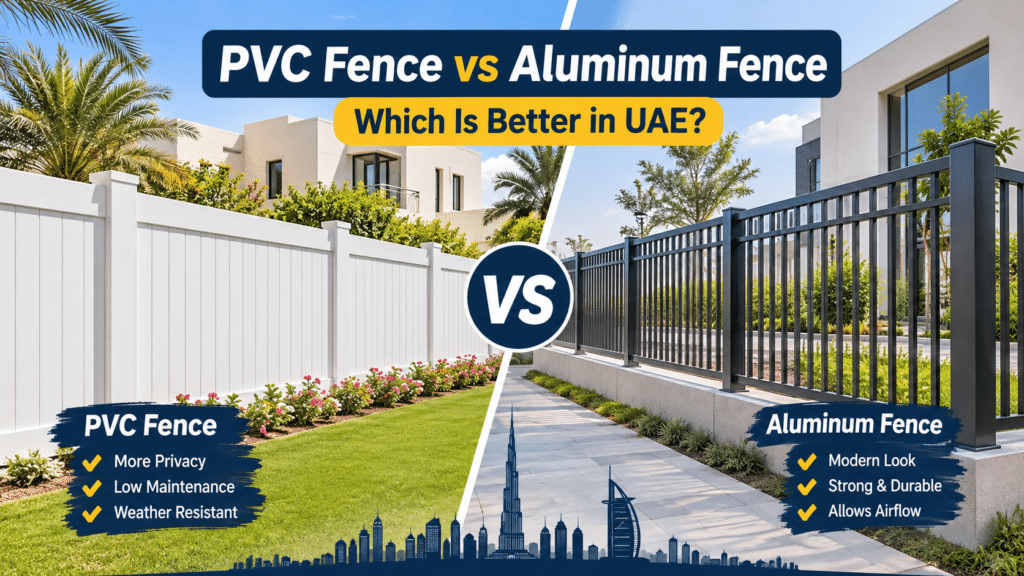
Choosing the right fencing material is an important decision for homeowners and businesses in the UAE. A good fence should improve privacy, enhance the property’s appearance, and provide reliable protection against outdoor conditions. However, the UAE climate creates additional challenges because fencing materials must withstand intense sunlight, high temperatures, humidity, dust, and occasional strong winds.
Two popular options for modern properties are PVC fencing and aluminum fencing. Both offer attractive designs and relatively low maintenance, but their performance, appearance, privacy levels and installation requirements differ.
When comparing PVC fence vs aluminum fence, it is important to understand which material suits your property’s location and purpose. PVC fencing is often preferred for private gardens, villa boundaries and enclosed outdoor spaces, while aluminum fencing is popular for contemporary properties that require strength, visibility and an elegant appearance.
The right choice also depends on material quality, UV protection, corrosion resistance and professional installation. A low-quality fence may not perform well under continuous outdoor exposure, even if its initial price seems attractive.
In this guide, PVC Fence vs Aluminum Fence based on UAE weather conditions, durability, maintenance, appearance, installation and overall value. Whether you are planning a residential or commercial fencing project, understanding these differences will help you select a suitable long-term solution.
If you are considering PVC fencing for your property, exploring professional PVC fencing solutions in UAE can help you understand available designs, privacy features and installation options. Choosing a suitable fencing system from the beginning can make a significant difference to its appearance and long-term performance
PVC Fence vs Aluminum Fence: Understanding Their Differences and Performance
Before selecting a fencing material, it is helpful to understand how each option is manufactured and how it performs in different outdoor environments. Although both materials are suitable for various applications, they offer different advantages.
What Is a PVC Fence?
PVC stands for polyvinyl chloride, a synthetic plastic material widely used in construction and outdoor applications. PVC fencing is designed to create attractive boundaries without many of the maintenance problems associated with traditional wooden fencing.
Most PVC fences consist of hollow or reinforced profiles that connect to form complete panels. Depending on the design, they can provide full privacy, decorative boundaries or simple garden enclosures.
One of the biggest advantages of PVC fencing is its resistance to moisture. Unlike untreated wood, it does not rot or absorb water in the same way. It is also resistant to termites and does not require regular painting or staining.
PVC fencing is available in different colours, heights and styles. White privacy fencing is a popular option for residential gardens, while other finishes can complement different architectural designs.
For residential properties that require privacy and a clean outdoor appearance, an ECO PVC fence is worth considering. Din Fence offers PVC fencing solutions designed for villas, gardens and other outdoor spaces, with features such as moisture resistance, low maintenance and modern appearance.
What Is an Aluminum Fence?
Aluminum fencing is manufactured using aluminum or suitable aluminum alloys. It is commonly used for residential, commercial and architectural projects because it combines lightweight construction with good structural strength.
Unlike ordinary steel, aluminum does not develop iron rust. It naturally forms a protective oxide layer that helps resist corrosion. Many outdoor aluminum fences also feature powder-coated finishes to improve their appearance and provide additional surface protection.
Aluminum fencing offers considerable design flexibility. Homeowners can choose vertical bars, horizontal slats, decorative panels and contemporary patterns according to their property’s style.
It is particularly suitable for modern villas, gardens, commercial entrances and outdoor spaces where an open appearance is preferred.
Another advantage is its ability to allow airflow through open designs. This can be useful in the UAE, where homeowners may want a boundary that provides separation without completely blocking natural light and visibility.
The quality of the alloy, coating and connecting hardware should always be checked before installation, especially for properties exposed to coastal humidity.
How Do PVC and Aluminum Fences Perform in UAE Weather?
Weather resistance is one of the most important factors when choosing outdoor fencing in the UAE. Materials must handle prolonged sunlight, high temperatures, humidity and dust without losing their functionality or appearance.
PVC fencing can perform well in outdoor environments when manufactured with suitable UV stabilisers. However, prolonged exposure to strong sunlight can affect lower-quality PVC, potentially causing fading, discolouration or deterioration.
Temperature changes can also cause PVC to expand and contract. Therefore, proper installation spacing and suitable panel connections are important to accommodate natural material movement.
Aluminum generally performs well under high-temperature conditions. It does not rot or rust like ordinary iron-based materials, making it suitable for many outdoor applications.
Its protective coating helps maintain its appearance, although poor-quality finishes can deteriorate when exposed to harsh environmental conditions.
For UAE installations, neither material should be selected without checking its outdoor specifications. A product designed for mild climates may not provide the same performance under continuous desert sunlight.
Resistance to UV Rays and Extreme Heat
Strong sunlight is a major consideration for PVC fencing in Dubai, Abu Dhabi, Sharjah and other UAE locations. Continuous UV exposure can gradually affect plastic materials, particularly products without appropriate stabilisation.
High-quality PVC fencing is manufactured with UV-resistant additives that help reduce the effects of prolonged sunlight. These products are generally more suitable for exposed outdoor installations.
Aluminum fencing also needs protection from direct sunlight. Powder coating helps preserve the surface finish and provides additional protection against environmental exposure.
Both materials can experience temperature-related changes. PVC may expand or contract, while aluminum also undergoes thermal expansion. Correct installation techniques help accommodate these movements.
When purchasing a fence, ask the supplier about UV resistance, coating specifications and the manufacturer’s recommended outdoor applications.
Moisture, Humidity and Coastal Conditions
Humidity and salty coastal air can affect fencing materials, particularly in properties located near beaches and waterfront developments.
PVC has an advantage because it does not rust or rot. Its moisture-resistant properties make it suitable for many outdoor applications where water exposure is expected.
Aluminum is also a suitable choice for humid environments because it does not rust like ordinary steel. However, its protective coating and connecting components still require attention.
For example, unsuitable steel screws or brackets can develop corrosion even when the main aluminum panels remain in good condition.
If your property is near the sea, choose appropriate corrosion-resistant fasteners and a suitable outdoor finish. These small details can contribute significantly to the durability of the complete fencing system.
Durability and Structural Strength
Durability is another important difference when comparing PVC fence vs aluminum fence.
PVC offers good resistance to moisture, termites and rot. It is particularly useful for residential boundaries where privacy and appearance are priorities.
However, PVC may be more vulnerable to strong impacts. Depending on the profile construction, a heavy impact can crack or damage a panel. Product quality and reinforcement influence its resistance to everyday wear.
Aluminum generally provides better structural strength and resistance to many everyday impacts. It is lightweight but can support a wide range of residential and commercial fencing designs.
Although aluminum is durable, it is not completely damage-proof. Strong impacts can cause dents or scratches, and damaged protective coatings should be inspected.
The actual lifespan of either material depends on manufacturing quality, environmental exposure, installation and maintenance. Therefore, always check product specifications and warranty coverage before purchasing.
Maintenance Requirements and Cleaning
One of the reasons homeowners choose PVC and aluminum fencing is their relatively low maintenance requirements.
PVC fencing has a smooth surface that makes cleaning simple. Dust and ordinary dirt can generally be removed using water and mild soap. Unlike wooden fences, it does not require regular painting or staining.
Aluminum fencing is similarly easy to maintain. Occasional washing helps remove dust, while periodic inspections can identify loose connections, scratches or coating damage.
In the UAE, dust accumulation is common, especially around roads and construction areas. Regular cleaning helps both materials maintain their appearance.
For either option, avoid abrasive cleaning materials and aggressive chemicals. These can damage PVC surfaces or affect protective coatings on aluminum.
Overall, both materials are convenient for property owners who want attractive outdoor fencing without demanding maintenance routines.
Privacy and Airflow: Which Material Is Better?
Privacy is one of the clearest differences between PVC and aluminum fencing.
PVC fencing is often preferred for private gardens, patios and villa backyards because solid panels can restrict outside visibility. This makes it easier to create a comfortable outdoor environment away from neighbouring properties.
Standard aluminum picket fencing usually has spaces between its bars, allowing people to see through the boundary. This makes it suitable for front gardens and entrances where visibility is desirable.
However, aluminum slat fencing offers a balance between privacy and airflow. Horizontal or angled slats can reduce direct visibility while allowing some air to pass through.
Your decision should depend on how you plan to use the space. If complete privacy is your priority, PVC is generally the more straightforward choice. If you prefer an open, modern boundary, aluminum offers greater flexibility.
Design, Appearance and Customisation
The appearance of your fence can influence the overall look of your property. It should complement the building’s architecture, landscaping and exterior colour scheme.
PVC fencing is commonly available in simple, clean designs, including solid privacy panels, decorative pickets and traditional rail styles. White is a popular choice because it creates a bright and neat appearance.
Aluminum fencing offers more flexibility for contemporary designs. It can be manufactured in different colours, heights, slat arrangements and decorative patterns.
For example, horizontal aluminum slats can complement modern villas, while vertical bars provide a more traditional appearance.
Both materials can improve the property’s exterior when selected carefully. Consider the overall architectural style instead of choosing a fence based only on its appearance in a product catalogue.
Installation Requirements and Site Preparation
Professional installation plays an important role in the performance of any fencing system. PVC fences require properly positioned posts, aligned panels and suitable support. Installers must also follow the manufacturer’s recommendations for expansion and contraction.
Aluminum fences require accurate measurements, secure fixing points and consistent alignment. This is particularly important for horizontal slat systems, where uneven spacing can affect the finished appearance. Ground conditions may influence both installations. Uneven surfaces, sloped gardens, existing boundary walls and gate openings can require additional preparation.
Before installation, a site inspection helps determine post spacing, foundation requirements, fence height and suitable fixing methods. A professionally installed fence is more likely to provide stable performance and maintain its appearance over time.
Proper installation is essential for achieving reliable fencing performance in the UAE. Working with experienced professionals can help ensure accurate measurements, secure foundations and correct panel alignment. You can explore Din Fence’s professional fence installation services to learn more about its installation, transportation and maintenance support.
PVC Fence vs Aluminum Fence: Cost Comparison in UAE
The cost of fencing in the UAE depends on several factors, including material quality, dimensions, design complexity and installation requirements.
Basic PVC fencing may be an economical choice for straightforward privacy applications. However, premium UV-stabilised products and reinforced profiles can increase the overall cost.
Aluminum fencing prices depend on the alloy specification, panel thickness, coating, colour and design. Custom-made horizontal slat systems may require more fabrication than standard picket fencing.
Installation expenses also influence the final quotation. Site preparation, foundations, gates, accessories and transportation may add to the project cost.
When comparing suppliers, request quotations based on similar specifications rather than comparing only the advertised price per metre.
Consider these factors when evaluating the overall cost:
- Material quality and thickness.
- UV protection or protective coating.
- Fence height and total installation length.
- Posts, brackets and connecting hardware.
- Gate requirements and additional accessories.
- Installation, foundations and site preparation.
Before finalising your fencing budget, it is always helpful to compare material quality, installation requirements and the overall project cost. Choosing experienced fencing contractors in Dubai can help you identify a suitable solution based on your property’s layout, privacy requirements and budget.
Choosing the Best Fence for Your UAE Property: Recommendations and Buying Guide
After understanding the differences between PVC and aluminum, the next step is deciding which material is suitable for your property.
The best option depends on your intended application, privacy requirements, location, budget and preferred appearance. A residential garden may need different features from a commercial entrance or swimming pool boundary.
Which Fence Is Better for UAE Villas?
Villa owners often want fencing that improves privacy while maintaining an attractive exterior.
PVC fencing can be a practical choice for backyards and private garden areas because its solid panels help create an enclosed space. It also offers relatively simple maintenance, which is useful for busy homeowners.
Aluminum fencing may be more appropriate for front boundaries, where visibility and architectural appearance are important.
Some property owners combine both materials. For example, aluminum can be installed at the front entrance, while PVC fencing can provide additional privacy around the backyard.
The right arrangement depends on the property’s layout and the surrounding architectural style.
Which Material Is Better for Gardens?
Garden fencing should provide suitable boundaries without negatively affecting the outdoor environment.
PVC fencing is useful when you want to separate your garden from neighbouring properties or create a private seating area.
Aluminum fencing is suitable for decorative garden boundaries where airflow and visibility are important. Open designs can also help maintain a less enclosed appearance.
Before selecting a design, consider the position of plants, garden lighting and outdoor seating areas. A solid fence and an open fence can create very different outdoor experiences.
Is Aluminum Fencing Suitable for Swimming Pools?
Aluminum is commonly considered for swimming pool fencing because its open designs provide visibility and a modern appearance.
However, pool fencing is not simply a decorative installation. It must meet applicable safety requirements concerning barrier height, openings, gates and access control.
PVC may also be considered for certain pool boundary applications, particularly where privacy is required. However, the selected product must be appropriate for the intended safety function.
Always confirm applicable regulations and safety specifications with the relevant authority or a qualified fencing professional before installing a pool barrier.
What Is Better for Commercial Properties?
Commercial properties often require fencing that combines appearance, durability and practical functionality.
Aluminum fencing is suitable for offices, retail spaces, hotels and commercial entrances where a modern appearance and visibility are desirable.
PVC can be useful for enclosed service areas, private outdoor sections and locations where screening is more important than visibility.
The final choice should reflect the purpose of the installation. A customer-facing entrance may require a decorative design, while a storage or service area may need a more private boundary.
For larger projects, consider material specifications, installation standards and long-term maintenance before making a final decision.
What Should You Check Before Buying Fencing in UAE?
Selecting a reliable product and supplier is just as important as choosing between PVC and aluminum.
Ask about the material specifications, outdoor suitability, UV resistance, protective coatings and warranty coverage. For aluminum, check the finish and corrosion-resistant hardware. For PVC, confirm UV stabilisation and profile construction.
It is also important to understand what the installation quotation includes. Confirm whether posts, foundations, brackets, gates, accessories and finishing work are included in the price.
If your property is within a managed residential community, check the applicable fencing guidelines before ordering. Some developments have specific requirements concerning boundary height, colours and external appearance.
A professional site assessment can help you avoid unnecessary expenses and select a system that meets your actual requirements.
Common Mistakes to Avoid When Choosing a Fence
Many homeowners focus entirely on the initial purchase price and overlook the importance of product quality.
Choosing a low-quality PVC product without suitable UV protection can lead to appearance and performance problems after prolonged outdoor exposure.
Similarly, selecting aluminum without considering the protective coating and connecting hardware may create avoidable maintenance issues.
Another mistake is installing solid panels without considering wind exposure. Large solid surfaces can place additional pressure on posts and foundations.
Finally, do not overlook local property requirements. Always confirm whether approval is necessary before installing or modifying a boundary fence.
Frequently Asked Questions
1. Is PVC fencing suitable for the UAE climate?
Yes. Outdoor-grade PVC fencing with suitable UV stabilisation can be used in the UAE. However, product quality and correct installation are important for handling prolonged sunlight and temperature changes.
2. Does aluminum fencing rust?
Aluminum does not rust like ordinary steel because it naturally forms a protective oxide layer. However, protective finishes and connecting hardware should still be maintained, particularly in coastal environments.
3. Which fence offers better privacy?
PVC generally provides better privacy because solid panels restrict outside visibility. Standard aluminum picket fencing is more open, although slat designs can provide partial screening.
4. Is PVC fencing cheaper than aluminum fencing?
Basic PVC fencing may cost less than some customised aluminum systems. However, the final price depends on material quality, dimensions, design and installation requirements.
5. Which fencing material requires less maintenance?
Both materials require relatively little maintenance. PVC can be cleaned with mild soap and water, while aluminum requires occasional cleaning and inspection of its protective finish.
6. Can aluminum fencing be customised?
Yes. Aluminum fences are available in different colours, heights, finishes and decorative patterns. Custom designs can complement modern villas and commercial properties.
7. Can PVC fencing fade in sunlight?
Lower-quality PVC may fade or discolour after prolonged UV exposure. Choosing outdoor-grade PVC with suitable UV stabilisers helps reduce this risk.
8. Which fence is better for coastal UAE properties?
Both can be suitable. PVC does not rust, while aluminum offers good corrosion resistance when properly specified. Suitable fasteners and protective finishes are important for coastal installations.
9. Is aluminum stronger than PVC fencing?
Aluminum generally offers better structural strength and resistance to many everyday impacts. However, actual performance depends on material quality, panel design and installation.
10. Can PVC and aluminum fences be installed together?
Yes. Combining both materials can provide a practical balance. Aluminum can be used for an open front boundary, while PVC can provide privacy in gardens or backyard areas.
Conclusion
When comparing PVC fence vs aluminum fence, there is no single option that is best for every UAE property. Both materials offer useful advantages, and the right selection depends on your requirements.
PVC is a practical option for homeowners who prioritise privacy, moisture resistance and easy maintenance. Aluminum is often more suitable for properties requiring structural strength, contemporary designs, visibility and airflow.
Both can perform well in UAE outdoor conditions when the correct specifications, protective features and installation methods are selected.
Before making your decision, consider your property’s location, exposure to sunlight, coastal conditions, wind requirements and overall design. Comparing product quality and complete installation quotations will help you make a more informed investment.
At Din Fence, choosing the right fencing solution starts with understanding your property’s needs. Whether you are planning a private villa boundary, a modern garden fence or a commercial installation, selecting suitable materials and professional installation can help create an attractive and dependable outdoor space.
Explore the fencing solutions offered by Din Fence and find an option that matches your property’s appearance, privacy requirements and outdoor conditions.
Explore Professional Fencing Solutions by Din Fence
Choosing between PVC and aluminum fencing becomes easier when you have access to the right products and professional guidance. At Din Fence, you can explore different fencing solutions designed for residential, commercial and industrial properties across the UAE.
Whether you need a private garden boundary, durable perimeter fencing or professional installation, our team can help you understand the available options.
-
Explore our fencing solutions in UAE for different property requirements.
-
Learn about our fencing installation and maintenance services.
-
Discover experienced fencing contractors in Dubai for your next project.
-
Contact Din Fence to discuss your fencing requirements and request a quotation.